

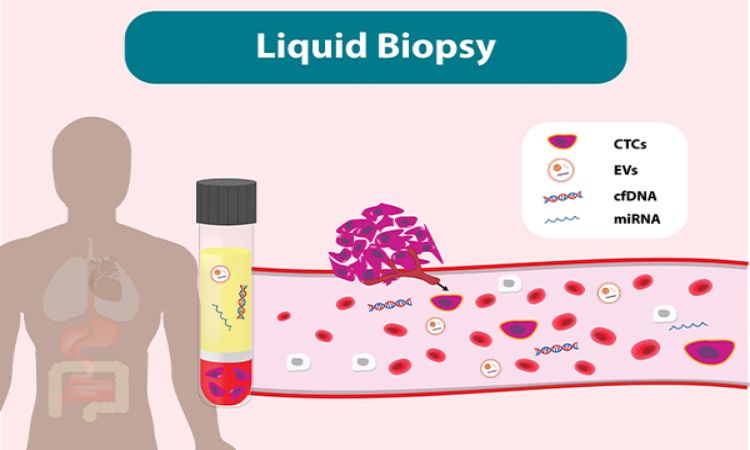
Liquid biopsy has been a revolutionary initiative in cancer detection as a non-invasive tumour profiling method to identify different markers circulating in the body, especially tumour DNA.
However, traditional tissue biopsy still remains the gold standard for early cancer diagnosis, and in many places, liquid biopsy is a sought-after tool for fast-track monitoring and evaluation of treatment.
Unlike traditional tissue biopsies, liquid biopsies are performed on a simple blood or urine sample, making the process less painful, safer, and repeatable.
Benefits Of Liquid Biopsy
The advantage of the liquid biopsy approach is early detection for personalized treatment plans by drawing molecular insights about the patient’s cancer without using invasive tissue biopsies.
Liquid biopsies can rapidly detect circulating tumour DNA (ctDNA) and other associated components to indicate the stage of the cancer incident long before a tumour starts appearing on imaging.
Liquid biopsies also identify and analyse various tumour-derived components, such as ctDNA, which are fragments of DNA dropped by cancer cells. Circulating tumour cells, or CTCs, are cancer cells delinked from the tumour, but they enter the bloodstream.
Where To Test Liquid Biopsy
Now, for the question of where to do reliable liquid biopsy testing, you can find an array of service providers.
In the Indian cities, the liquid biopsy testing is offered by players like 4baseCare, Dr Lal PathLabs, Ganesh Diagnostic, Max Lab, and Karkinos Healthcare. Another prominent name is MedGenome, with services across cities in India.
The liquid biopsy test costs usually range from INR 25,000 to INR 2 lakhs, depending on the number of markers to be detected.
Consumers requiring liquid biopsy testing will make sure that the laboratory chosen has all accreditations, such as NABL and NABH accreditations.
In the choice of best labs to do liquid biopsy, the criteria of advanced Next-Generation Sequencing (NGS) technology are also a significant differentiator.
The focus on accuracy, reliability and availability of home sample collection for convenience and test service, actionable mutations for targeted therapies also swings the choice of lab.
Best For Seamless Monitoring
Liquid biopsy is gaining traction mainly because of the minimally invasive approach. It is far less risky and never painful, as in a needle biopsy. This is a bonanza for patients who are too weak and frail. It also helps in tracing tumours in hard-to-reach locations.
Real-Time Tracking Of Tumour Changes
Given the fact that cancer is a dynamic disease with the genetic profile changing fast even during treatment, the liquid biopsy approach is very beneficial in seamless monitoring. The doctors can track the tumour in real time and ascertain if the treatment is working well or the cancer is showing resistance.
The flipside of single-tissue biopsy is that it captures just a small part of a tumour and misses out on the genetic heterogeneity within various cancers.
In liquid biopsy, the detected ctDNA will be tracked from the angle of origin as well as other sources, including metastatic sites, to create a complete picture of the genetic landscape.
Final Thoughts
To sum up, the use of liquid biopsies in cancer detection continues to unravel many new areas of advantage, including timely alerts on any relapse into the disease even after treatment, much earlier than the results from traditional imaging tests.
