

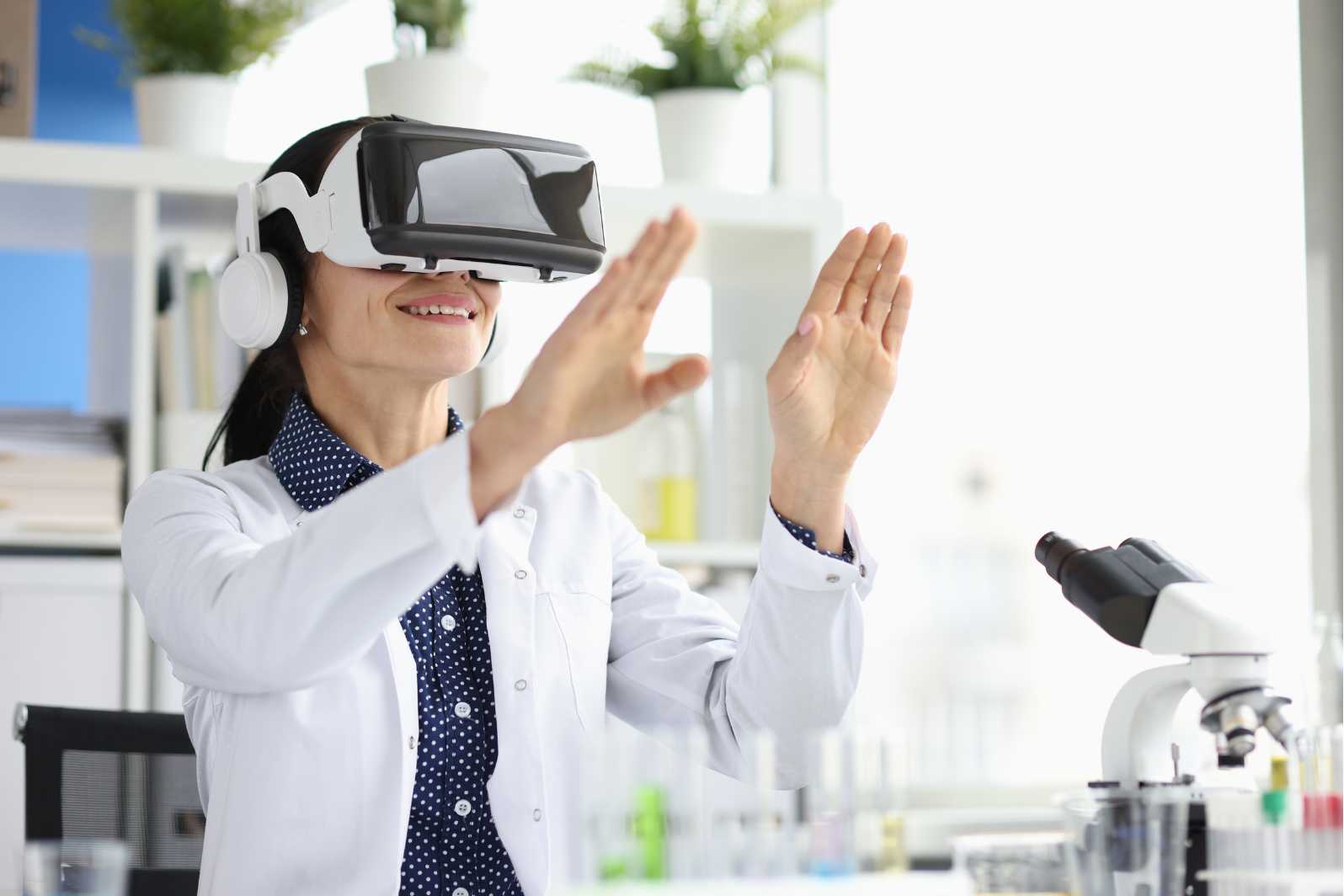
STEM education focuses on science, technology, engineering and mathematics. These are the subjects of all future innovation and problem-solving. But because the subjects can seem abstract, many students find them challenging. This is where XR (Extended Reality) fits in. It allows for hands-on experiences in classrooms without the need for physical labs. With XR, students can enter a digital world where they can tinker, encounter new things and learn in a captivating way.
What is XR?
XR, extended reality, is a term that refers to virtual reality (VR), augmented reality (AR) and mixed reality.
- VR (Virtual Reality): Allows students to enter and navigate a fully digital world.
- AR: Places digital objects such as Pokemon characters on top of the real world when using phones, tablets or glasses.
- MR (Mixed Reality): Can let digital and real objects interface with each other.
Put simply XR is the combining of the real world and the digital world, in a way that makes learning more engaging.
Why XR in STEM Matters
Many STEM concepts require hands-on work. For example, learning how molecules join together, or how an engine operates, or experiencing gravity’s impact on motion can be made more comprehensible if students able to “see” it. XR does this by making it possible for theory to become an interactive experience. Students can traverse among the planets, not just read about them.
Hands-On Science with XR
1. Virtual Labs
Some schools don’t have the money to support advanced labs. With XR, students are able to conduct experiments without any danger and at a fraction of the price. A chemistry student can virtually mix chemicals without fear.
2. Engineering Simulations
Maker spaces, like those at school libraries, are not active in XR and so students can build a machine, test a bridge the built, or construct circuits inside of XR. And they can actually see how forces in the real world play out on their creations without fancy, expensive equipment.
3. Exploring Biology
With XR, a student can zoom inside the human body, watch cells function, follow blood flow through veins. The hands-on view is a better learning tool than printed diagrams in books.
4. Space Exploration
Rather than simply reading about planets, XR provides students the ability to “stand” on Mars, see Earth from space or experience gravity differences across various planets.
5. Mathematics in 3D
Abstract mathematical concepts, such as geometry,vectors and calculus are easy to understand when students can see 3D spaces with XR technology.
Benefits of XR in STEM
- Better Comprehension: Students are able to see and feel virtual objects, facilitating deep learning.
- Safety in the Lab: Hazardous experiments are no longer unsafe when conducted in a virtual laboratory.
- Cost Savings: Schools also save money on lab equipment when they use XR simulations.
- Anywhere Accessible: Learn from home using XR headsets or even mobile devices.
- Spurs Curiosity: XR is fun to learn in, which keeps students interested.
Challenges of XR in STEM
- Cost of Devices: VR headsets and XR setups remain too pricey for many schools.
- Teacher Training: Teachers must be trained to effectively use XR in classrooms.
- Access to technology: Rural students may not be able to afford or access high-speed internet services and devices.
The Future of XR in Education
XR is forecast to be the fastest-growing sector in education. The more affordable devices are, the more schools will acquire them. Already, companies are developing XR-based science kits and classroom apps. XR might be integrated with how we learn in the future, much like books and blackboards.
FAQs:
Q1. What are the distinctions between VR, AR and XR in education?
VR puts in you a complete digital learning environment, AR overlays digital elements onto the real world and XR is the umbrella term for both-plus mixed reality.
Q2. How does XR support STEM learners?
It does this by making science and math more exciting, turning theories into hands-on experiences like virtual labs, 3D models and simulations.
Q3. Is XR affordable for schools?
Currently, XR can be costly. As technology progresses, however, more cost-effective XR tools are entering the classroom.
Q4. Can XR replace the real labs in schools?
XR is not a substitute for real labs, but it might be an excellent supplement, especially under resource-poor conditions.
Q5. Are special devices required for students to learn in XR?
Yes, they need devices such as VR headsets, AR glasses, or even smartphones and tablets to do it.
